THOUSANDS OF FREE BLOGGER TEMPLATES

Monday, October 31, 2011

Fall Feeding... I Hope It's Not Too Late

The seasons are definitely changing- the nights are chilly, leaves are covering the lawn, and I frequently have to scrape frost off the windshield in the morning.  It has snowed a few times up in the Bighorn and Pryor mountains, but we have stayed snow free so far down here in the valley.  In fact, my son and I were up in the Pryors a couple of days ago cutting our last load of wood for the winter as the snow was falling.  It has been a beautiful fall, though.  Without a real hard frost yet the leaves have all had a chance to turn and fall on their own.  It seems like so often we get a cold spell in October that freezes the leaves before they have a chance to turn on their own.

The bees have been getting less and less active as the temps have gotten cooler.  I'm sure they are clustering at night but do get out and about as the days warm up- we have been getting up into the 50's and 60's still here in town. 

We are down to one hive going in to the winter.  Virginia ended up with laying workers toward the end of the summer and finally died out.  Georgia recovered nicely from her swarm last spring and has been healthy and strong coming in to fall.

Last year we extracted honey at the first of September and then tried to feed sugar syrup to prepare the hives for winter, but the bees ignored the sugar syrup completely- I couldn't get them to take any of it.  There must have been plenty of nectar coming in during September and October because they had plenty of stores to get them through the winter.  So this fall I figured they would have enough and didn't try feeding them.  A while a go I hefted Georgia's hive and found that it was incredibly light.  I don't know what the difference is between this year and last, but it appears that there must not have been much of a fall nectar flow this year.

Last week I prepared 2 gallons of sugar syrup mixed 1 1/2 parts sugar to 1 part water.  I also added a little bit of Honey B Healthy.  Honey B Healthy contains some essential oils that are supposed to help honeybees remain healthy and strong.  I don't know if it really helps or not, but I have a bottle of it and figure it probably doesn't hurt.  According to all the books I have seen, sugar syrup for fall feeding should be mixed in a 2:1 ratio, but I have not had much luck keeping that in solution- it keeps crystallizing on me.  I bet the bees don't really care what the concentration is.  Anyway, it took the bees just a couple of days to consume the first two gallons.  I prepared a second batch a couple of days ago.  Here is a photo of the bees in the feeder.
Sorry the bees do not show up very clearly.  (You can see our leftover tomato plants in the background- time to get those cleaned up.)  When I first got the feeder the bees' feet couldn't cling to the smooth surface of the plastic guard and bees drowned in the syrup by the dozens.  I took a wire brush and scuffed up the inside of the guard creating tiny little grooves that the bees' feet could catch.  Now very few bees drown, but it doesn't make for great pictures of bees feeding on the syrup.

I don't know how long it will be before it gets too cold and the bees stop taking the syrup, but I will feed them as long as they do.  I hope they can get enough stored up to make it through the winter.  I am already planning on supplemental feeding in the late winter/early spring.

This winter we will be ordering a replacement colony to take Virginia's place.  I hope to get a Russian queen and compare them with the Italian mutts living in Georgia.  I don't know what we will name the new colony of Russian honeybees.  Maybe a nice Russian name like Sasha or Svetlana.  Any suggestions?

Sunday, September 18, 2011

Honey Harvest 2011

This post is a little overdue- two weeks ago we harvested our honey.  I actually pulled the supers off Georgia and extracted the honey a couple of days later.  Virginia ended up with laying workers this summer and has now died out completely.

As I was removing the supers I removed each frame one at a time and removed the bees.  The top couple of supers, which were the last ones to be put on, were full of capped honey- nearly every frame was 100% capped.  The lower three supers had several frames that were full of uncapped nectar.  I found it curious that the newest supers had more capped honey than the older ones.  I had removed the queen excluder earlier in the summer because the bees kept sealing it off and blocking their own ability to move up into the supers.  Consequently there was a little bit of brood up in the bottom super.  I wonder if the fact that the brood chamber was sitting a little higher could explain why there was less capped honey down low.  Anyway, by the time I switched out all the uncapped frames with capped frames I had 4 full supers.

This first photo shows uncapping a frame of honey with a heated uncapping knife.

As the hot knife removed the caps it frequently leaves a thin layer of wax over the tops of the cells.  This next photo shows the scratcher that I used to very lightly remove that thin layer of wax.
You can also see the uncapping tank I devised to catch the honey that drained off of the caps.

In this next photo you can see the extractor we used and a filter over the five gallon bucket.
Filtering is the slowest step of the whole extracting process.  Since it does go so slowly, we extracted most of the honey into buckets and filtered it after the fact. This last photo is of the unfiltered honey in a five gallon bucket.
 In the end we extracted 133 pounds or about 11 gallons.

We let the caps drain for a couple of days and filtered that honey a little later.  When it was all done we added about five pounds of honey to the total.

Now we have a bunch of beeswax that will need to be melted down and cleaned up.  I don't know what we will do with the wax this year.  Maybe we will try some candle making.

Monday, August 22, 2011

Uncapping Tank Design

Here is the uncapping tank I designed and built this year. I designed one last year that had a few flaws- mainly that I had a difficult time removing the caps from the tank without dropping them down into the honey. Hopefully this years design will correct that problem.


I am no engineer nor did I try for great precision when I built this thing. I just kind of eyeballed the cuts- It's not the prettiest, but I think it will work.


First I have a photo of what the final product looks like.


I started with 2 identical plastic bins that nest one inside the other.


I took one of the bins and drilled holes down in the corners on the sides, cut a notch in the top and cut the bottom completely out.


I then shaped a piece of hardware cloth to the length and width of the floor of the bin. I formed loops and wired it all in place so two wooden dowels could slip in the ends.


The hardware cloth fits inside the plastic bin and dowels slip through the holes in the corners of the bin, through the hardware cloth loops, and out the holes on the other side. The dowels need to be long enough to extend a couple of inches beyond the sides of the bin.


I cut notches down in the sides of the top corners of the second bin as seen in the photo above.
The dowels extending out from the first bin fit down into the notches of the second bin.
Finally, a small piece of wood fits across the notches cut into the top of the first (top) bin. I used a 1X2.

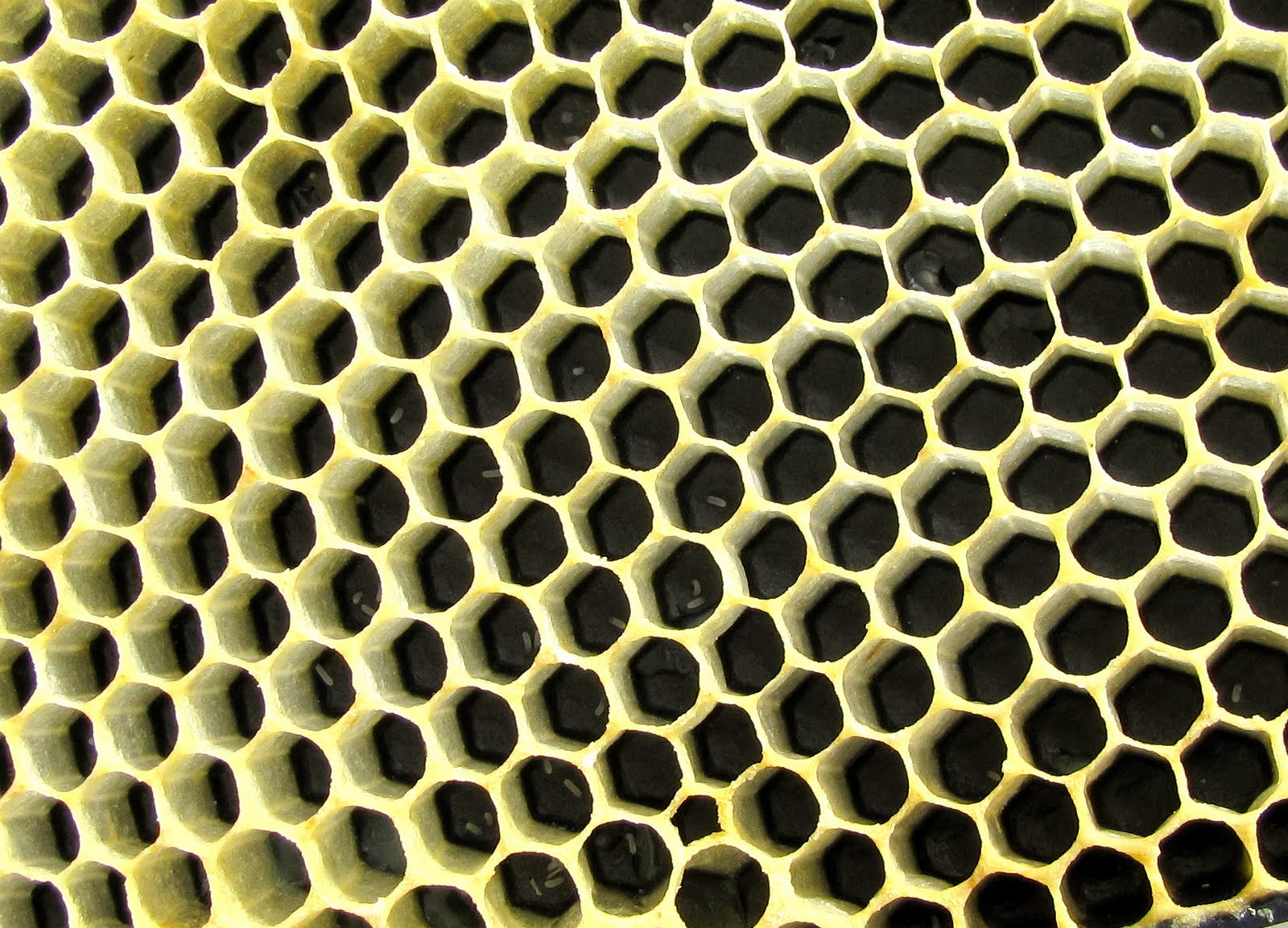
The strip across the top is used as a rest for the frame you are uncapping. As the caps fall from the frame they land on top of the hardware cloth in the bottom of the top bin. The honey then drains through the harware cloth and into the bottom bin. When all the honey has drained, the top bin can be lifted off and the honey can be poured out of the bottom bin and through a filter.


I intended to install a honey gate in the bottom bin to make it easier to transfer the honey to other containers but I never got around to ordering one. If this design works out I will install one for next year.

Sunday, August 21, 2011

Laying Workers

It's for sure. We have laying workers. I have known this for the last week or so but have been to busy (read lazy) to post it all to the blog.

If you want to read about when I found the cells with multiple eggs you can find it here.

I have read about several different methods for getting rid of laying workers, all of which take time. The question now is- Do I have time to get rid of the laying workers and requeen the hive in time to get the population and stores built up and ready for winter? I don't really know, but it seems pretty late in the season to me. I have decided to cut my losses with this hive and start this hive over next spring.

I have moved all the honey supers form Virginia over to Georgia. Georgia swarmed early in the summer and took quite a while to start filling up her supers. She has a booming population now and with Virginia's supers she is stacked up with 5 supers total.

Before Virginia lost her queen she was well on her way to filling at least 4 supers with honey. Last year (our second with the bees) we also had queen problems in both hives and extracted a total of 6 supers. Just think how much honey we could extract if we could just get a good year without any swarms or supercedures or laying workers!

Since Virginia will die out this fall and winter anyway, I am removing the deep frames from the hive to harvest what honey I can. In the empty space left in the deep hive bodies I am hoping that the remaining workers will try to rebuild the comb with fresh wax. That will just give me more wax to harvest before winter. We will see how that goes.

So now we are just waiting for Virginia to finish capping her honey. We plan on extracting the honey in early September. Last year I designed and built an uncapping tank. It worked but had some design flaws. This year I have modified the designed and built another that I think will work a little better. That will be the subject of the next blog post.

Wednesday, August 3, 2011

I Don't Know!!

I wish I could figure these bees out. Just when I think I know what is going on I am perplexed by a whole new set of circumstances. Let me start from the beginning.

As we all know, Virginia had been queenless for a while and I had ordered a new Russian hybrid queen from the Walter T Kelley company in Tennessee. While the hive was to be queenless I removed the queen excluder just to make sure there was nothing to hinder the workers from putting honey away in the supers. Walter T Kelley couldn't ship the queen right away due to the heat wave occurring in the Midwest at the time. They shipped her off to me last week and she arrived on Friday.

I went out to introduce the new queen on Saturday morning at about 10:00. The day was just beginning to warm up and the temp was in the low to mid 80's. Here is a photo of the Russian hybrid queen and 5 attendants.
I rigged up some wire and part of a coat hanger with which to hang the cage in the hive. Sorry you can't see the bees very well. The queen should stay in her cage for a while so the rest of the hive can get used to her scent. If she is released too soon she will be killed.

Anyway, I set the queen cage off to the side in the grass while I got into the hive. Virginia was stacked up with 4 supers. The top super was still empty, the next was about 50% filled with nectar, and in the next one I saw the following three photos. (I hope you can click on the photos and get a closer view. Sometimes Blogger works that way with my photos and sometimes it doesn't.)


Multiple eggs in the cells! Two things are wrong with this. First of all there was no queen. I know this because there had been no eggs or brood for quite some time and I did not see any queen cells in the hive before she went queenleess. Second of all there are multiple eggs in the cells. I saw some cells with up to 5 eggs in them. To me this looks like the work of laying workers: my worst nightmare come true. (If you are unfamiliar with laying workers click here for a quick explanation) Laying workers are very difficult to get rid of, and this late in the summer I don't know if there would be time to rescue the hive even if I were able to get rid of the blasted things. In any case, once you have laying worker(s) it does no good to introduce a new queen because all the bees think they have a laying queen and will kill the new queen as soon as she is released.

I finished looking through the hive and found no eggs in the deep hive bodies which were nearly full of honey. I then put the hive back together and picked up the new queen wondering what I would do with her now. As it turned out I didn't need to wonder at all. As the sun heated up overhead it baked the queen and her attendants- they were all dead in the cage! What a day! I was really bummed out about the prognosis of the hive. I did not realize that I had become emotionally attached, not to the individual bees but to the hive as one single organism.

I convinced myself that there might be a little bit of hope left. If I had missed a queen cell before Virginia went queenless and she had just started to lay, she might be laying multiple eggs in a cell before she gets her laying legs under her. That did actually happen when Georgia superceded last year. Is it possible? Yes- but I think chances are pretty slim.

Today I got back into the hives. I figured that if there could be a new queen in Virginia then I needed to make sure she was down in the deep hive bodies so the honey supers don't get turned into the brood nest. I went through each super frame by frame and brushed every bee down into the top deep hive body and reassembled the supers. I looked for eggs and brood also and found that about 50% of the cells with eggs had multiple eggs and about 50% had single eggs. Only a few of the larva that had hatched were being capped- most were drone cells (indicative of laying workers) but a couple looked like workers. So maybe a queen?

Now see if you can follow my logic for what I did next. A) Virginia has a relatively small population of bees since bees have been dying but have not been replaced since there has not been a queen. B) Virginia had tons of space with 4 supers and relatively few bees. C) Georgia's population has been growing as she has been queen-right since her swarm early in the summer but has much less space with only 3 supers. D) If Virginia does not have a queen but does have laying workers then drone brood will continue to muck up the frames of honey that are being stored in her supers since laying workers can move up and down through the queen excluder.

So here is what I did. I removed a couple deep frames of honey in the upper deep hive body and replaced them with frames of empty comb. Hopefully this will give the queen (if there is one) space to lay eggs. I then found all of Virginia's frames with any eggs or brood and condensed them down into a single super and put that back on above the queen excluder and put an empty super on top of that. I took all of Virginia's frames of honey and combined them together into a couple of supers and put them on top of Georgia. Now Virginia may or may not be queen-right and has 2 supers. Georgia is queen right and is very tall with 5 supers- one of them is empty, one is about 50% full, and 3 are nearly 100% full.

Do I know what is going on inside of Virginia? Nope. Am I doing the right things to manage the situation? Not sure of that either. Maybe in a week or two I will have a better idea- or maybe I won't.

Sunday, July 24, 2011

Garden Bees

I got the camera back yesterday after missing it for a few weeks. I had to go out this morning and find some bees in the garden that would pose for some pictures.

This first photo is one of the bees pollinating our yellow squash.


This next photo shows a bee collecting nectar from one of the many clover blossoms in our lawn.


This next set contains photos of the hollyhocks. They are a good source of pollen- they produce a ton of it. But I think the bees use them as a nectar source as well.


These last two are photos of a bee as it was pollinating our cantaloupe vines.


The cucumbers do have blossoms but I could not find any bees on them this morning. We also have some sunflowers at one end of the garden. I am sure we will have some pictures of them later on this summer.

Saturday, July 23, 2011

Progress Is Slow

I peeked in on the bees today. They are making little progress in the honey supers. I guess there probably is not a real strong nectar flow going on right now. The alfalfa flow was pretty intense at first but as the summer goes on it becomes less and less intense even though it continues to bloom. As the hay alfalfa grows after it is cut and blooms again we should get another strong flow for about a week or so. I understand that spotted knapweed is blooming right now in other parts of the country. Do we even have spotted knapweed here in Wyoming? And if so, do we have enough around Lovell to even make a difference?


Anyway, I checked them out last week and found that Virginia still had no eggs. I could have moved a frame of eggs from Georgia over to Virginia and let them raise a new queen, but that would have taken extra time to raise her, wait for her to mate, and then wait for her to get into a good laying routine. I decided to order a Russian hybrid queen from The Walter T Kelley Company. They could not ship her this week due to the high heat in the Midwest- nobody wants a cooked queen to arrive in the mail. She will be shipped early next week. The queen plus shipping and handling cost about $30- now that's an expensive bug! It does seem like a lot if you think of her as just a bug, but it seems pretty reasonable to me considering all you get out of her.

I decided to go with a Russian hybrid for a few of reasons. I have heard that they are hard workers and don't mind chilly rainy weather. I have read comments from other beekeepers in the Beesource forums that Russians will get out and start working before the sun is all the way up and even when it is chilly and rainy. They have said that when their other bees are tucked away inside the hives the Russian are out working. Another reason is that Russians apparently build up more slowly in the spring. That might not be good for southern beekeepers who need big numbers for strong nectar flows in March, but I am hoping that it will translate into fewer bees and thus less swarming before the big nectar flow starts in June. I have also read that they are a very hardy breed and over-winter better than other breeds and that they are more naturally resistant to mites, nosema, and other pests. These last reasons are not as critical to me as I have not seen a single varroa mite or any other pest in the three years I have had my bees, they have not had any problem over-wintering, and so far nosema has not been bad enough to cause any lasting effect on either hive.

I mentioned in my last post that Georgia had filled the queen excluder in with wax and had effectively sealed the workers out of the supers. I had cleaned out the excluder and placed it back on the hive. Last week they were in the process of sealing it off again, so I removed it completely. Today I was a little worried that the queen might have moved up and laid eggs in the honey supers. Both of the supers were full of bees but there were no eggs or brood up there. That is good. Last year I removed the excluder and ended up with brood in the supers and then had a heck of a time getting the queen back down in the deep hive bodies.

So there we are- Virginia is still queenless with four supers. The bees are making slow progress filling them up with honey. Her Russian hybrid queen should arrive sometime next week. Georgia is queen-right and is also making slow progress in the two supers on top of her hive.

Some good news- Chris and the kids are coming home today! I have not seen them for 2 weeks. It will be so nice to have everybody home again. They are also bringing the camera back with them so next post there should be some pictures to accompany all this text.

Related Posts Plugin for WordPress, Blogger...