THOUSANDS OF FREE BLOGGER TEMPLATES

Monday, December 5, 2011

The Jet Stream Is Dipping Low

Brr... It is cold.  We woke up to zero degrees Fahrenheit (that's negative 17.7 degrees Celsius) this morning!  Here is what the jet stream looks like today:
No wonder is it so cold here in Wyoming, but it looks like North Dakota probably has it worse than us.  I bet the bees are in a tight cluster today!


Wednesday, November 9, 2011

Honey Beats Dextromethorphan!

I came across this article yesterday at the American Pharmacists Association's website.  One more reason to support your local beekeeper.

I am not sure when this article was published by APhA, but the study they cite in Archives of Pediatric and Adolescent Medicine was published in 2007.

Honey more effective than honey-flavored dextromethorphan for children's coughs


Key point: A study published in Archives of Pediatric and Adolescent Medicine found that children who received a single dose of buckwheat honey 30 minutes before bedtime slept better and coughed less than those who received honey-flavored dextromethorphan or no treatment at all.

Finer points: The primary outcome measure of this partially double-blinded, randomized study was to compare parental satisfaction with a single nocturnal dose of buckwheat honey, honey-flavored dextromethorphan, or no treatment at all in children experiencing nocturnal coughing from an upper respiratory infection (URI). A total of 105 children aged 2 to 18 years with URI, nocturnal coughing, and duration of illness 7 days or less were enrolled in this study, which took place in a single, outpatient, general pediatric practice.

On the first night of the study, each child received no treatment. The next morning, parents answered five questions concerning cough frequency and severity, bothersome nature of cough, quality of child's sleep, and quality of parent's sleep. Survey responses were stratified using a seven-point Likert scale. On the second night, each child was randomized to receive a single syringe containing 2.5 mL, 5 mL, or 10 mL of buckwheat honey or honey-flavored dextromethorphan, or nothing. The syringes for all of the treatment groups were opaque and were placed in brown paper bags to ensure investigator blinding. The honey and dextromethorphan groups were blinded to patients and parents because the two products had similar consistency, texture, flavor, smell, and sweetness. Parents answered the same five questions the following morning.

Overall, parents rated honey as significantly better than dextromethorphan or no treatment for all five criteria (P < 0.001). Mild adverse events (e.g., hyperactivity, nervousness, insomnia) were significantly more common in children treated with honey than those treated with dextromethorphan or nothing (P = 0.04).

What you need to know: The recent FDA announcement that the Consumer Healthcare Products Association is voluntarily modifying the product labels of all OTC cough and cold medicines to state that the products should not be used in children under 4 years of age has left pharmacists with virtually no cough products to recommend for children in this age group. While additional research is needed to confirm the findings of this study, pharmacists should consider recommending honey as a symptomatic treatment for cough. Honey is safer than dextromethorphan in terms of abuse potential and possible serious adverse events (e.g., dystonia, anaphylaxis, psychosis, death). In addition, no published findings demonstrating the efficacy of dextromethorphan in children are available.

What your patients need to know: Tell parents that honey has been used as an alternative medicine since ancient times. Exactly why or how honey improves coughing is not known; it may be its viscosity or its antioxidant properties. Encourage parents to purchase only unfiltered, unheated, unprocessed honey and to never give honey to children under 1 year of age, because honey can contain botulism spores in its natural form.

Sources

Sunday, November 6, 2011

The Seasons Are Changing

It looks like winter is on its way!  Yesterday we got our first snow of the year.  It has snowed up on the mountains a few times already, but this was the first snow down here in town.  It didn't snow a lot, just enough to cover the grass and ice up the windshield.

Here is a picture of the hive in the little bit of snow we did get.
Not much snow there, but it is chilly enough to keep the bees inside today.

This next picture was taken inside the feeder that I still have in place.
I think the bees must be clustered up in the top of the hive just under the left side of the feeder.  It looks like the cluster is overflowing up into the feeder.  If you look closely, though, you can see some of the bees lined up on the bottom with their heads pointing down- they are feeding on the sugar syrup.  I hope it stays warm enough long enough for the bees to finish off this last batch of syrup.  We are supposed to warm back up to about 50 degrees F (That's about 10 degrees Celsius) later this week.

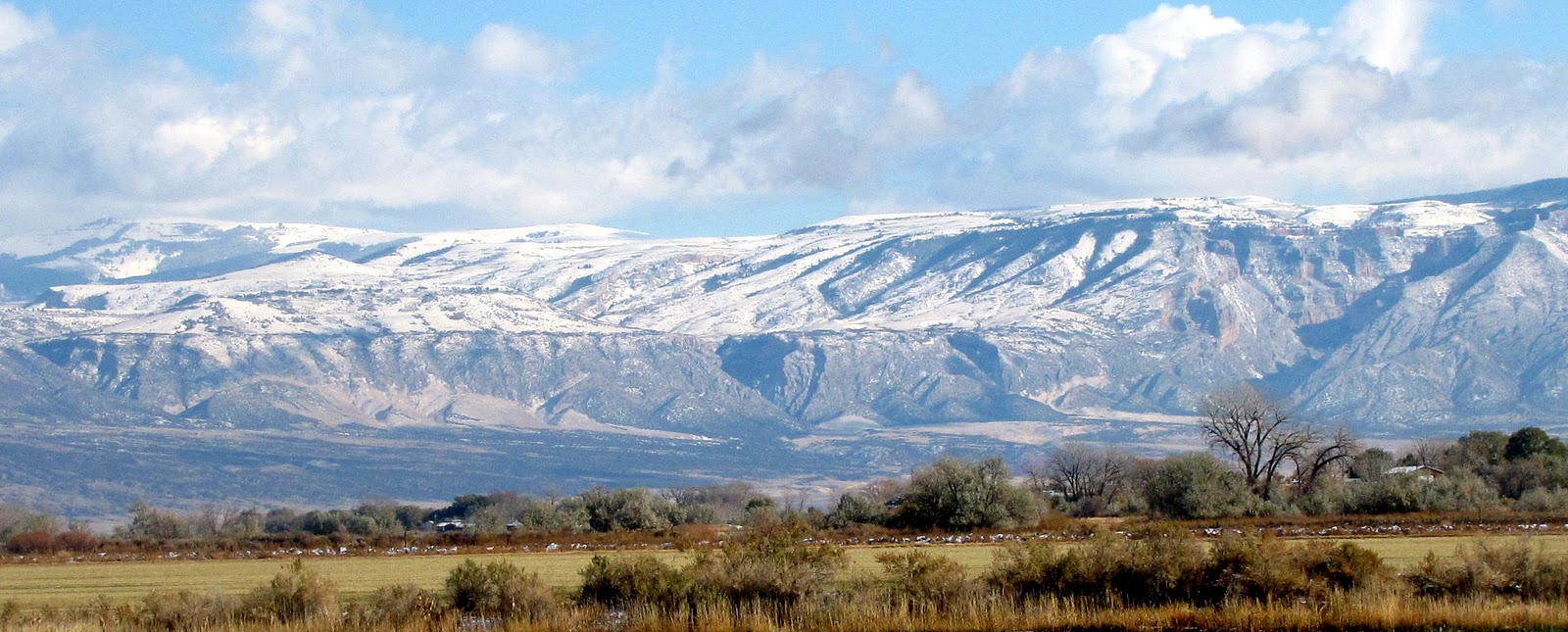
The following are a few pictures of the Bighorn mountains which I took this morning.  The Bighorns run north and south.  We live just on the west side of the mountains so these pictures are looking east at the western slope.  You should be able to click on the photos and see larger view.


I love the Bighorn mountains!  I think they are one of the most beautiful places on earth and feel truly blessed to live where I do.

Monday, October 31, 2011

Fall Feeding... I Hope It's Not Too Late

The seasons are definitely changing- the nights are chilly, leaves are covering the lawn, and I frequently have to scrape frost off the windshield in the morning.  It has snowed a few times up in the Bighorn and Pryor mountains, but we have stayed snow free so far down here in the valley.  In fact, my son and I were up in the Pryors a couple of days ago cutting our last load of wood for the winter as the snow was falling.  It has been a beautiful fall, though.  Without a real hard frost yet the leaves have all had a chance to turn and fall on their own.  It seems like so often we get a cold spell in October that freezes the leaves before they have a chance to turn on their own.

The bees have been getting less and less active as the temps have gotten cooler.  I'm sure they are clustering at night but do get out and about as the days warm up- we have been getting up into the 50's and 60's still here in town. 

We are down to one hive going in to the winter.  Virginia ended up with laying workers toward the end of the summer and finally died out.  Georgia recovered nicely from her swarm last spring and has been healthy and strong coming in to fall.

Last year we extracted honey at the first of September and then tried to feed sugar syrup to prepare the hives for winter, but the bees ignored the sugar syrup completely- I couldn't get them to take any of it.  There must have been plenty of nectar coming in during September and October because they had plenty of stores to get them through the winter.  So this fall I figured they would have enough and didn't try feeding them.  A while a go I hefted Georgia's hive and found that it was incredibly light.  I don't know what the difference is between this year and last, but it appears that there must not have been much of a fall nectar flow this year.

Last week I prepared 2 gallons of sugar syrup mixed 1 1/2 parts sugar to 1 part water.  I also added a little bit of Honey B Healthy.  Honey B Healthy contains some essential oils that are supposed to help honeybees remain healthy and strong.  I don't know if it really helps or not, but I have a bottle of it and figure it probably doesn't hurt.  According to all the books I have seen, sugar syrup for fall feeding should be mixed in a 2:1 ratio, but I have not had much luck keeping that in solution- it keeps crystallizing on me.  I bet the bees don't really care what the concentration is.  Anyway, it took the bees just a couple of days to consume the first two gallons.  I prepared a second batch a couple of days ago.  Here is a photo of the bees in the feeder.
Sorry the bees do not show up very clearly.  (You can see our leftover tomato plants in the background- time to get those cleaned up.)  When I first got the feeder the bees' feet couldn't cling to the smooth surface of the plastic guard and bees drowned in the syrup by the dozens.  I took a wire brush and scuffed up the inside of the guard creating tiny little grooves that the bees' feet could catch.  Now very few bees drown, but it doesn't make for great pictures of bees feeding on the syrup.

I don't know how long it will be before it gets too cold and the bees stop taking the syrup, but I will feed them as long as they do.  I hope they can get enough stored up to make it through the winter.  I am already planning on supplemental feeding in the late winter/early spring.

This winter we will be ordering a replacement colony to take Virginia's place.  I hope to get a Russian queen and compare them with the Italian mutts living in Georgia.  I don't know what we will name the new colony of Russian honeybees.  Maybe a nice Russian name like Sasha or Svetlana.  Any suggestions?

Sunday, September 18, 2011

Honey Harvest 2011

This post is a little overdue- two weeks ago we harvested our honey.  I actually pulled the supers off Georgia and extracted the honey a couple of days later.  Virginia ended up with laying workers this summer and has now died out completely.

As I was removing the supers I removed each frame one at a time and removed the bees.  The top couple of supers, which were the last ones to be put on, were full of capped honey- nearly every frame was 100% capped.  The lower three supers had several frames that were full of uncapped nectar.  I found it curious that the newest supers had more capped honey than the older ones.  I had removed the queen excluder earlier in the summer because the bees kept sealing it off and blocking their own ability to move up into the supers.  Consequently there was a little bit of brood up in the bottom super.  I wonder if the fact that the brood chamber was sitting a little higher could explain why there was less capped honey down low.  Anyway, by the time I switched out all the uncapped frames with capped frames I had 4 full supers.

This first photo shows uncapping a frame of honey with a heated uncapping knife.

As the hot knife removed the caps it frequently leaves a thin layer of wax over the tops of the cells.  This next photo shows the scratcher that I used to very lightly remove that thin layer of wax.
You can also see the uncapping tank I devised to catch the honey that drained off of the caps.

In this next photo you can see the extractor we used and a filter over the five gallon bucket.
Filtering is the slowest step of the whole extracting process.  Since it does go so slowly, we extracted most of the honey into buckets and filtered it after the fact. This last photo is of the unfiltered honey in a five gallon bucket.
 In the end we extracted 133 pounds or about 11 gallons.

We let the caps drain for a couple of days and filtered that honey a little later.  When it was all done we added about five pounds of honey to the total.

Now we have a bunch of beeswax that will need to be melted down and cleaned up.  I don't know what we will do with the wax this year.  Maybe we will try some candle making.

Monday, August 22, 2011

Uncapping Tank Design

Here is the uncapping tank I designed and built this year. I designed one last year that had a few flaws- mainly that I had a difficult time removing the caps from the tank without dropping them down into the honey. Hopefully this years design will correct that problem.


I am no engineer nor did I try for great precision when I built this thing. I just kind of eyeballed the cuts- It's not the prettiest, but I think it will work.


First I have a photo of what the final product looks like.


I started with 2 identical plastic bins that nest one inside the other.


I took one of the bins and drilled holes down in the corners on the sides, cut a notch in the top and cut the bottom completely out.


I then shaped a piece of hardware cloth to the length and width of the floor of the bin. I formed loops and wired it all in place so two wooden dowels could slip in the ends.


The hardware cloth fits inside the plastic bin and dowels slip through the holes in the corners of the bin, through the hardware cloth loops, and out the holes on the other side. The dowels need to be long enough to extend a couple of inches beyond the sides of the bin.


I cut notches down in the sides of the top corners of the second bin as seen in the photo above.
The dowels extending out from the first bin fit down into the notches of the second bin.
Finally, a small piece of wood fits across the notches cut into the top of the first (top) bin. I used a 1X2.

The strip across the top is used as a rest for the frame you are uncapping. As the caps fall from the frame they land on top of the hardware cloth in the bottom of the top bin. The honey then drains through the harware cloth and into the bottom bin. When all the honey has drained, the top bin can be lifted off and the honey can be poured out of the bottom bin and through a filter.


I intended to install a honey gate in the bottom bin to make it easier to transfer the honey to other containers but I never got around to ordering one. If this design works out I will install one for next year.

Sunday, August 21, 2011

Laying Workers

It's for sure. We have laying workers. I have known this for the last week or so but have been to busy (read lazy) to post it all to the blog.

If you want to read about when I found the cells with multiple eggs you can find it here.

I have read about several different methods for getting rid of laying workers, all of which take time. The question now is- Do I have time to get rid of the laying workers and requeen the hive in time to get the population and stores built up and ready for winter? I don't really know, but it seems pretty late in the season to me. I have decided to cut my losses with this hive and start this hive over next spring.

I have moved all the honey supers form Virginia over to Georgia. Georgia swarmed early in the summer and took quite a while to start filling up her supers. She has a booming population now and with Virginia's supers she is stacked up with 5 supers total.

Before Virginia lost her queen she was well on her way to filling at least 4 supers with honey. Last year (our second with the bees) we also had queen problems in both hives and extracted a total of 6 supers. Just think how much honey we could extract if we could just get a good year without any swarms or supercedures or laying workers!

Since Virginia will die out this fall and winter anyway, I am removing the deep frames from the hive to harvest what honey I can. In the empty space left in the deep hive bodies I am hoping that the remaining workers will try to rebuild the comb with fresh wax. That will just give me more wax to harvest before winter. We will see how that goes.

So now we are just waiting for Virginia to finish capping her honey. We plan on extracting the honey in early September. Last year I designed and built an uncapping tank. It worked but had some design flaws. This year I have modified the designed and built another that I think will work a little better. That will be the subject of the next blog post.

Related Posts Plugin for WordPress, Blogger...