THOUSANDS OF FREE BLOGGER TEMPLATES �

Saturday, February 12, 2011

February Thaw

It finally warmed up a little- enough for the bees to get out for some cleansing flights. I walked over to the hives today and saw little yellow spots all over the snow. I also saw several bees who went out to relieve themselves, got chilled, and crash landed on the snow never to see the inside of their hive again. Some people think this is kind of sad, but I have always thought of the entire hive as being one organism. If some bees are lost I am not bothered as long as the individual hive remains healthy.

Since it was a little warmer today I wanted to see how the bees were doing and how much honey they have left. I had a chance to pop the tops back in the first part of January- at that time both clusters were in the upper deep just below the medium supers that are sitting on top. I wasn't sure how much honey they might have gone through since then so I thought it might be a good idea to have something ready to feed them just in case. Last year I tried the mountain camp method of feeding- that mostly left a big mess in the hives. I didn't have anything else ready to go so I filled a couple of pint jars with some old crystallized honey and figured I could lay them down on their sides on top of the frames. That would give me time to whip up some bee candy to put in on Monday or Tuesday. (It is supposed to keep getting into the upper 30's and 40's for a few more days.) Here is a picture of the emergency feed I had ready to go.

I first opened up Georgia's hive and this is what I found:Georgia's cluster appears small. I am not sure if it really is that small or if the majority of the cluster was still down below. I did not want to disturb them too much to find out. She still has about 7 medium frames of honey left.

I next popped open Virginia's hive. This is what I found under her cover:Virginia's cluster covers about half of the medium super. She also has about 7 medium frames of honey left in her super.

I decided I did not need to provide the crystallized honey as emergency feed today. I will make some bee candy this weekend and place it in the hives on Monday. I think I might put both the honey and the bee candy in at the same time. It will be interesting if they take all the honey before starting on the candy, or if they will take them simultaneously. I have never made bee candy before so this will be a new adventure. I will use a recipe I found on beekeeping.com.

At this point it looks like Virginia has the healthier hive and larger colony. Last year it was just the opposite and Georgia had a booming hive while Virginia struggled all spring. They both ended up requeening themselves last summer so I don't know which one has the better queen now.

Lastly, we drove up to Cody this morning to run a few errands. As we were driving back I noticed that the willow trees up there are turning bright orange. Willows are probably the first plants that offer the bees any kind of forage each spring. From what I have been able to research on the internet it looks like bees use willows for both nectar and pollen. This does get me a little excited for spring to arrive, but I know that we are still a long way off from any significant nectar flow. It is hard to be patient.

Wednesday, February 9, 2011

So Cold!!

I am sick and tired of the cold!!

Wednesday, January 5, 2011

Hive A Happy New Year

It's a new year and the bees have been doing their winter thing. They have spent the first part of this year tightly clustered inside the hives. In fact, they have spent the last month or so in tight clusters. There were a few days at the end of November when we had some temps warm enough for the bees to clean out some of their dead. Since then, however, I don't think a single bee has stuck its head outside the hives. We have had a few weeks of temps hovering around zero degrees F and only a few days at or above freezing. With the cold weather I have not seen any yellow spots in the snow- they have not been able to get out for any cleansing flights. They can sure hold it for a long time.


I walked over to the hives on New Year's Day and brushed the drifted snow out of the entrances. As I was bent down near the entrance I could hear the buzz from the cluster without knocking on the sides. I am not 100% sure but I think that is good news. I am pretty sure it means that since I could hear them so easily the bees must still be down in the bottom deep hive body. Bees usually start the winter in the bottom of the hive and move up as they consume the honey they have stored. Since they are still in the bottom, they still have the upper deep and the medium super to get them through the rest of the winter.

Here is what the hives are looking like on this cold January day.
I hope everyone had a good 2010 and that 2011 will be even better!

Monday, December 6, 2010

Bee Pollen And Warfarin

I heard about a case study in the American Journal of Health-System Pharmacy which describes an interaction between bee pollen and warfarin resulting in an elevated INR. In other words, taking bee pollen along with warfarin (an anticoagulant or "blood thinner") could cause "thinner blood" and increase the chance of bleeding. I do have to mention that calling anticoagulants "blood thinners" is one of my pet peeves. The viscosity of blood is not affected; its ability to clot is.

The full article cannot be viewed without a password, but the abstract is available. If you could read the full article you would find that the interaction is most likely due to the variety of flavenoids in the bee pollen which inhibit warfarin metabolism by the liver. Anyway, you can read the abstract here if you would like.

Sunday, November 28, 2010

I See Dead Bees

I know the bees are alive because I saw a bunch of their dead today.


We have had such a mild fall this year. We had highs in the 60's clear into November. The last few weeks have turned cold and snowy, though. I hadn't seen the bees in quite a while and then the snow came. It blew into the entrances and froze in place so the bees had no way to get out even if they wanted to. I pressed my ear against the sides of the hives and knocked- last winter I could always hear a buzz coming from inside, but this time I heard nothing. I was a little worried that they were not ready for the cold snap and that something had happened to them. I shouldn't have worried- bees have been taking care of themselves for millions of years.

I took a walk over to the hives today and saw some good news- dead bees. With the warmer temps the last few days the ice in the entrances melted and the bees began clearing out some of the dead that had accumulated inside the hives. There were about 10 dead bees laying on top of the snow in front of each hive. As the winter progresses we will find more bees that die and are cleared out by the bees left inside. They are very hygienic creatures.

Sunday, November 7, 2010

Crystallizing Honey

It's happening a little earlier than it did last year.


Last year we extracted honey in September and it finally started crystallizing in about March. This year we extracted at the beginning of September and we have been seeing signs of crystallization for a couple of weeks now. The honey is getting cloudier and cloudier. I guess this year there must have been more nectar sources with higher glucose contents. Honey with a high glucose content will crystallize more quickly and honey with a high fructose content will crystallize more slowly- it all depends on the nectar source. I could tell that this year's honey is a little different from last year's- it is a little darker in color and its flavor is, for lack of a better work, a little "fuller".

It really doesn't bother me that is crystallizing now- it is not difficult to reliquify. Besides that, a sticky honey jar is one of my pet peeves. We use a lot of our honey on top of oatmeal, and the kids are always stickifying the jar when they transfer honey to the oatmeal. Once it crystallizes the kids can scoop out some crystallized honey without making a mess- the honey relifquifies as it is mixed into the hot oatmeal. It's a win-win. The kids still get their honey and I don't have to deal with a sticky honey jar!

Tuesday, October 19, 2010

Fall Feeding

Fall is here and that means it is time to feed the bees.

At the beginning of September we harvested honey and stole all the honey the bees made this summer. Now it is time to make sure the bees have enough stores to get them through the winter. Since we pulled the honey early in September the bees had a fall nectar flow from sunflowers, goldenrod, and a few other blooms that occurred this fall. Besides their 2 deep hive bodies I left them each a medium super to fill back up with honey. To be sure they have enough, I am supplementing their feed with sugar syrup.

They say that in the fall you should make the sugar syrup in a 2:1 (sugar to water) mixture- this is supposed to stimulate honey storage. In the spring you are supposed to feed with sugar syrup in a 1:1 mixture to stimulate brood production. I don't know why this makes a difference to the bees, but that is what the experts say. Last fall I fed a 2:1 mixture but had problems with the sugar precipitating and clogging up the feeder. This year I am using a 1.5:1 mixture and it seems to be working pretty well.

The first gallon of sugar syrup given to each hive this fall also contained fumagillin. Fumagillin is an antibiotic used to treat and prevent nosema. Nosema is a protozoan that likes to infect the GI tract of honeybees and cause dysentery. Feeding on sugar syrup that contains fumagillin all winter will hopefully keep the bees good and healthy.

Hear is a photo looking inside the feeder.
Last year a lot of bees fell down into the syrup and drowned. This year I took a wire brush and roughed up the inside of the plexiglass shield to give the bees feet little ridges to cling to. I don't think I have found any dead bees in the feeder this fall.
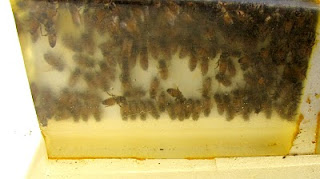
This photo shows the bees close up.

You can see them lined up across the feeder sucking up the syrup as they prepare for winter.

Related Posts Plugin for WordPress, Blogger...