THOUSANDS OF FREE BLOGGER TEMPLATES

Monday, June 14, 2010

Re-Queening

It looks like it is time to re-queen one of the hives. But I'm not doing it- the bees are taking care of that themselves.


Back on June 1st I reported that the queens in both hives had really slowed down in the brood production department. I was hopeful that they had slowed down because the nectar flow had slowed and that there was nothing seriously wrong with them.

As I started Georgia's inspection I could tell right away that things were different. This had been such a great hive which supplied us with the majority of the 75 pounds of honey we harvested last year. She survived the winter in nice style and built up explosively this spring. But as I started going through the supers today I could tell that the population had dropped off a little and there was no more honey in the supers now than 2 weeks ago. As I started making my way through the broodnest I did find capped brood, some larva, and a few eggs which had been laid in a spotty pattern. Finally I came across this frame seen below.

Here we have two empty queen cups and a capped supercedure queen cell near the top of this partially drawn frame. It looks like the bees are mounting a coup and preparing to replace the current queen. I will let this queen develop, mate, and take over the hive rather than ordering a new mated queen to install. Installing a new queen would require finding and getting rid of the existing queen. Since I haven't been able to find either queen since shortly after we installed the packages last spring, I'm not sure how successful I would be at finding her now. This whole scenario really is a little disappointing- I was hoping that this hive would keep booming and really pound out the honey this summer. Let's hope that we can recover from this little set back in time.

Virginia, on the other hand, seems to be doing a lot better. She has 2 medium honey supers- the first had fully drawn frames and the second had some partially drawn and some empty frames. The first super is almost filled with uncapped honey- the outer frames are about half filled and the central frames are completely filled and are starting to be capped. Up in the second super the bees are starting to draw more comb to fill with honey.

Down in the brood nest I discovered that the queen has picked up laying again- I found lots of eggs, larva, and capped brood all in a nice tight pattern. I also found 6 or 7 swarm cells/queen cups along the bottom of the frames of the upper deep hive body. The bees have plenty of room right now and I suspect that this past week of cool rainy weather made them go a little stir crazy and start thinking about swarming. I cut out the swarm cells (two of them had royal jelly but were not even close to being capped) and queen cups. With warm weather in the forecast maybe the bees will start working outside and stop thinking about swarming.

Sunday, June 6, 2010

Progress

We checked out the hives yesterday. It was a nice warm day and I just couldn't help myself. We didn't do a full hive inspection- just checked out the honey supers to see how much, if any, progress the bees were making.

The last time we checked the hives was just four days previous on June 1st. During that inspection I took a photo of one of the center frames of Virginia's first super above the brood nest. Yesterday Chris took a photo of that same frame- the two of them can be seen below. The top photo is from June 1st and the bottom photo is from yesterday.

On June 1st the bees had filled in about 2/3 of the frame with uncapped honey. Yesterday they had filled in almost the entire frame with the exception of a couple of spots at the bottom of the frame. I don't remember how quickly they filled in the honey supers last year, but this seems to be pretty good progress to me.

I don't know where they are finding the nectar- they don't seem to be touching the few dandelions that are still blooming and I haven't been able to locate any other major nectar sources in the area right now. It's a mystery.

Tuesday, June 1, 2010

Inspected The Hives Today

We had been out of town for the last 5 days and just made it home at about midnight on the first. My wife thinks that this is kind of strange, but I really missed the bees while we were gone and I thought about them a lot- always hoping that they were ok. I wonder how difficult it would be to set up a hive cam on this blog so I can keep tabs on them when I am not around.


The first thing I did when it warmed up a little this morning was get geared up to do an inspection. I found that the bees were incredibly docile- I did smoke them but I wonder if I could have done the whole inspection without smoke. I know that the veil wasn't necessary.


You may recall that I placed one medium honey super on each hive earlier in the spring when the dandelion and fruit tree nectar flows were beginning. A week later, Georgia's population was booming so I gave her another super just to give her a little more room. I checked the supers on both hives before we left last week and neither really needed another super at that time. I added a super to each anyway just in case some big nectar flow started while we were gone and the girls went wild with honey production. I gave Virginia her second super with partially drawn frames and Georgia a third super with empty frames.

I started with Georgia. Her top super of empty frames has not been touched. There were a few bees up there, but there was very minimal comb being drawn. Before removing each box I always crack it open a bit and puff a little smoke in to calm the bees before I open it up completely. This photo shows the bees reaction to the smoke. You can see their heads down in the cells gorging on honey.

This super has uncapped honey in about 5 of the 10 frames. None of the frames are completely full though. There is a little more honey than last time I checked but not much. I think we are between nectar flows right now- I wish the alfalfa would hurry up and start. I am thinking the cool spring this year pushed everything back a week or two.

This next photo shows the top of the bottom honey super- the one located directly above the brood nest.

Burr comb is what happens when you space out nine frames in a ten frame super and then place a super with ten frames above it. The frames don't all match up so the bees add extra comb where they think it belongs. It makes a bit of a mess to scrape out, but cleaning it up is quick and easy and it gives us extra wax to make beeswax hand balm/emolient or whatever you want to call it. I suppose as all ten of the frames in the super above are drawn out I could space those frames out to nine in the super as well. I discussed why I am going with nine frames in a super in the post dated May 14th.

As I made my way down into the bottom super I found lots of uncapped honey. However, in the center frames, the bees have been storing some pollen in the bottom half of the frames. It looks like they are expecting to use the bottom of the honey super frames as the top part of the brood nest. But with the queen excluder on the queen cannot make it up there.

Down in the brood boxes I found capped brood, some larva, and very few eggs. I am not 100% certain why there are so few eggs. I thought the queen must be having problems but then I discovered the same thing in Virginia and I wondered if it could be just a coincidence that both queens were having problems or if there was something else going on. After a little research I came across a power point presentation in which Michael Bush explains that during a nectar dearth queens will sometimes slow way down on the egg laying. I hope that this is what is happening now.

Anyway, it seemed that most of the broodnest was located in the upper deep hive body. I wanted to move the brood nest a little lower so the bees would fill in the super with honey instead of pollen so I reversed the brood boxes in an attempt to move the queen back down. I did not do this earlier in the spring because there were about equal numbers of eggs and brood in the upper and lower boxes. It looked like the queen was moving up and down in order to utilize all her space.

Virginia now has 2 medium honey supers. The first has 9 fully drawn frames spaced out in a 10 frame box and the second has 10 partially drawn frames. As I began the inspection I found that the bees had done some work on the comb of the top super but had not stored any nectar up there. The bottom super has uncapped honey in about 5 or 6 of the frames. Here is a photo of one of the center frames.

I has a beautiful color, doesn't it? You can see the curved line separating the filled and empty cells. That shape makes me wonder if Virginia is also trying to use the bottoms of these frames as part of the brood nest. I thought I would reverse Virginia's brood boxes as well but found that, while I did not find many eggs here either, most of the brood nest was already in the bottom box. Hopefully the bees will fill in the rest of these frames with honey when the next nectar flow gets going.

I guess I will leave them alone for a while and check them again when the alfalfa flow starts. Hopefully then the queens will pick up the egg laying and the bees will really start packing away the honey.

Tuesday, May 25, 2010

Correction

I have to make a correction to something I said in my previous post. I heard a piping queen during my last inspection and reported that the piping was from a new queen as she prepares to mate. I was informed (very politely) by someone reading the blog that I was mistaken and that the piping is from the old queen calling to the new queen so she can kill her. So sorry about that. And thanks for letting me know about my error- there is still so much to learn.

So I guess I must have a new queen that hatched from a supercedure cells that I had not seen. So why were the bees superceding? The old queen seemed to bo doing great. I just have to remember that bees are smarter than we are- they usually know what they are doing.

Anyway, I did more research on queen piping and came across this really interesting paper called "Listen to the Bees" by Rex Boys. He chronicled the research of Eddie Woods who studied the various sounds that bees make. He was a sound broadcast engineer and hobbyist beekeeper. The paper discusses some technical material that I had to read over a time or two, but it is quite interesting. You can find it here if you are interested.

Sunday, May 23, 2010

Piping Queen

I did a full inspection of both hives a few days ago. I think they are both looking good but I am not entirely sure what is going on inside Georgia. The results were as follows:

Georgia is still crammed full of bees. As I reported in an earlier post Georgia has been topped with 2 medium honey supers. I had originally put on only one super but a couple weeks ago or so I found that the hive was packed with bees from the bottom board to the outer cover. There was nectar being stored in the first super but none of it had been capped yet. I decided to add a second super just to give the bees a little more room. I provided a top entrance with the second super to make it easier for the bees to get in and out of the supers and hopefully make more honey. As of today, however, none of the bees seem to discovered the top entrance and I have not seen a single bee use it.

During this inspection I found uncapped nectar in both supers. Some of the frames in the first are filling up, but there is not much in the second. I think that we are kind of in between nectar flows right now; the fruit trees and dandelions are winding down and the alfalfa is not ready yet. Hopefully the alfalfa will get going before to long and the bees can really get busy. Alfalfa is the main nectar flow in the Big Horn Basin; it blooms continuously from maybe the end of May until maybe the beginning of October. Here is an interesting map with major nectar flow information.

Back to the inspection. I went through every frame of the brood nest to make sure there weren't any swarm cells and I didn't find any. That is a good thing. There were lots of eggs, larva, and capped brood. The photo below is a frame from the upper deep hive body.

I thought that the amount of capped brood here was pretty impressive. This queen is certainly prolific. The fact that this queen has been so great is the reason I am now a little confused as to what exactly is going on in there. You see, during the inspection a week or so ago I found capped brood and eggs, but no larva. I thought that was a little odd. This spring I have seen several queen cups; some up high in the frames (supercedure position) and some along the bottom of the frames (swarm position) but all had been empty. Until that last inspection, that is. At that time, as I lifted one of the frames out, I found a capped queen cell on the bottom of a frame (swarm position) but only one of them. When they are preparing to swarm they usually build several swarm cells. This queen cell must have been connected to the frame next to it as well because as I pulled it out it ripped the cell open and exposed the entire pupa inside. I cleaned it up with the hive tool replaced the frame.

Now fast forward to a few days ago- As I was down in the bottom deep I heard this warbling sound coming from inside the hive. It was loud enough to be heard over all the buzzing of the bees. I wasn't sure but I thought it might be the sound of a piping queen. I did an internet search and came across some recordings. Sure enough, that is exactly what I heard. Now, as I understand it, piping comes from a virgin queen as she prepares to mate. So, what do I have? A hive with the existing queen and a virgin queen that is preparing to swarm? Or a queen from a supercedure cell mounting a coup? And where did this piping queen come from? Scotland? OK- that was a bad joke, but I really have always wanted to go to Scotland and learn to play the bagpipes. Back to the subject at hand- I can't imagine that the bees would want to supercede this queen and I haven't seen any capped queen cells except for the one that broke open. What is going on here!?

As I opened Virginia I looked through her super and found lots of uncapped nectar so I did not add a second super at this time. I imagine I will have to add one once the alfalfa gets going.

Going through the brood nest I came across this little girl chewing here way out of her cell. See her photo below.


I am thoroughly impressed by Virginia's queen this spring. This hive struggled last summer and there wasn't a huge population going in to the winter. I was thinking of re-queening her this spring but never got around to it. I wonder if the bees re-queened themselves last fall because she has built up explosively this spring. While in the brood nest it seemed that bees were coming out of nowhere. I had to smoke to clear the bees out enough pull out a frame and after looking at if for about 15 seconds I would have to smoke again to move the bees out of the way to put the frame back in. I seriously could not see the frames in the box for all the bees covering them. I did find that there was lots of pollen and honey in the brood chamber and it looked like the queen might be running out of room so I expanded the broodnest by pulling a frame with honey and pollen from the edge and placing an empty frame in the middle. I hope we are almost through the spring swarm season so the bees can just get down to business and make us some honey!

Friday, May 14, 2010

Playing Catch-Up

A lot has happened since I last posted anything on this blog so I will catch up on what has been happening over the last couple of weeks.

About 2 weeks ago I inspected the hives. Everything seemed like it was cruising right along until I noticed something on one of Georgia's frames. This drone stood out with wings that looked a little different from the others. I separated it out where I could get a good look at it. Its wings are not horribly deformed but they are definitely smaller than the wings on the other drones and have a slightly more rumpled look. I was afraid that I had deformed wing virus in the hive. DFV is usually carried by varroa mites and I have not seen any other sign of the mites at all. I have checked under the screened bottom board and uncapped drone brood and have not come across a single one. This was the only bee I could find with this type of wing. I inspected Georgia this evening and did not come across any others so I am hoping that this bee was just a fluke and that all is well.

When I performed that inspection a couple of weeks ago the dandelions were starting to bloom and the fruit trees were about to start. I put on a queen excluder and a medium super on each hive and hoped that there would be enough of a nectar flow to get the bees started on honey production.

My plan with the queen excluder this year is this: I will start out with a queen excluder on since I tried it without one last year and ended up with brood up in the honey super. Once the bees have filled the first super with honey I will remove the excluder and use the first honey filled super as the excluder. As I understand bee behavior, the girls are sometimes reluctant to go through a queen excluder, but the queen does not like to cross over capped honey. So by removing the excluder after the first super is capped, I hope to boost honey production and at the same time keep the queen down in the bottom boxes.

The weather the last couple of weeks has been chilly and windy with a little rain here and there. It was amazing that even on chilly damp days there was still a steady stream of bees leaving the hives. One day, after it had rained the night before, I was able to take a picture of this bee drinking from some rain water which had collected in an old plastic wading pool tossed in the corner of the yard. We had put out a 5 gallon bucket with water for the bees but good luck telling those girls what they are supposed to do.

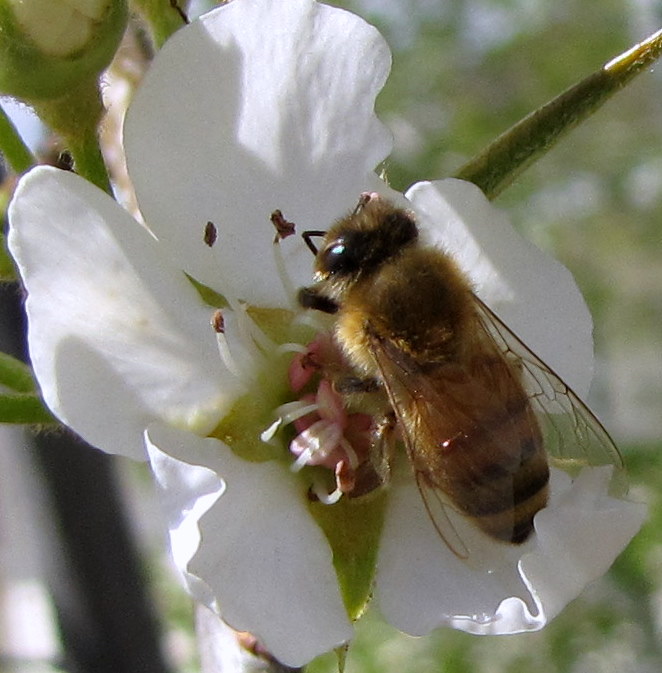
The fruit tree bloom did finally get started. We have a small apple tree and pear tree in our back yard, there is a large apple tree across the street, and there are lots of crabapple trees all over town. I have seen various bushes and hedges around town that have blossomed in pink, white, and yellow. I have no idea what they are but they have attracted the bees. Here is a shot of a bee on an apple blossom in our back yard.

The pear tree actually blossomed about a week before the apple tree did, but the bees pretty much ignored it until just a couple of days ago. They did finally find it and then really went after it.

That brings us to today. This evening I decided to see how Georgia was doing. I had to wait til I got home from work so there wasn't time to inspect both hives. When I took the outer cover off of Georgia I was amazed to see so many bees clogging up the medium super and completely filling the space between the inner and outer covers. I gave them a few shots of smoke (I'll tell you about the smoker in a minute) and cleared them out of the way and checked out the super. As you can see in this photo they had been busy collecting and storing nectar. This picture is pretty indicative of how much nectar was in all nine of the frames (I'll tell you about the switch to nine frames in a minute too.) Click on the photo to get a closer view of the nectar.


Ordinarily I would wait until most of the honey in this super was capped before adding another super, but since the hive was so full and crowded I thought it would be prudent to give the bees a little more space. So on went the second super and it is just the middle of May. I am surprised at how much nectar this hive has already collected- I think this may be a good year for honey.


I peeked in Virginia's super as well. She has stored nectar in all nine of her frames also, but has not collected as much as Georgia.


As I was closing everything up I saw this bee on the side of the hive. It looked so pretty with the evening sunlight shining through her translucent, honey colored abdomen.

Now, just a couple of foot notes:
1. Smoker: I have a new smoker fuel. I ran out of the cedar chips I had been using and remembered that we had some old pet litter in the basement called "Yesterday's News". It is made of old newspaper compacted down into little pellets. It worked well and burned for a long time. It doesn't smell nearly as nice as the cedar chips do, though.
2. 9 frame supers: Last year we used 10 frames in each of our 10 frame honey supers. However, when we went to extract the honey we found that it was difficult to uncap them as the caps did not extend beyond the edges of the frames. This year we bought some frame spacers and are going with 9 frames in a 10 frame super. This will hopefully allow the bees to draw the comb a little deeper so as to extend the caps beyond the edges of the frames and make it easier to uncap. I have read that you can only do this if you are using frames that already have fully drawn comb or the bees will draw it out unevenly or try to fill in the gaps with burr comb. We had about 25 fully drawn frames from last year (the others were all partially drawn but still had capped honey) so we are going with nine frames in the first two supers which we already added and will use 10 in the rest. Next year we should be able to go with more 9 frame supers.
Whew. There. We did it. It was a big job but we are finally all caught up. I will fill you in later as things continue to change.

Sunday, May 2, 2010

Bees On Dandelions

The bees are out in force on all of the dandelions in our yard. We have quite a patch behind the house- literally hundreds of dandelions. Let's hope I do a better job of keeping bees than I do of keeping a nice lawn.

Before I get to the photos of the bees and dandelions I will catch up with what has been going on around here. Back on April 22nd a bunch of bushes with pink blossoms and a few trees also with pink blossoms started to bloom. (I started an Excel spreadsheet to keep track of all my bloom dates. I am hoping that over the years this will help me be more prepared for what is coming.) Since Georgia was pretty full of pollen brood and honey I added the queen excluder and a medium super on April 24th. Shortly after this the weather turned south. We had several days of wind and cold (down to 24 degrees one night) and even a couple of days of snow. I was disappointed that the bees were unable to get out and take advantage of those blossoms. A few other fruit trees have popped out in blossoms, the apple trees are close, and the crabapple trees shouldn't be too far behind them. So we are close to some good nectar flows, but right now we have dandelions!

Here are some photos that I took this afternoon. The bees were everywhere! I had to pay attention to where I was kneeling to make sure I didn't squish any bees. These pictures aren't great, but I love taking pictures of my girls!

See the proboscis extending down to find the nectar.


I don't know what the problem here was. There were plenty of blossoms for everyone.


She has her head down sucking up the sweet nectar.


Sucking up the nectar again. Looks like she really had to go deep.


That is a pretty pollen sack, Don't you think?


Another one diving in


If you look closely through the petals just below the bees head you can see her proboscis extending down to get the nectar.

Related Posts Plugin for WordPress, Blogger...